

In the last few months, there has been a lot of buzz around the SpaceX IPO. Not only because it was the most expensive IPO in history, but also because it made many employees wealthy overnight. Unlike many other companies, SpaceX gives shares to anyone working at the company, not just a selected part of the workforce. With approximately 7,661 workers at its campus and manufacturing facility in Hawthorne (Los Angeles County), SpaceX’s IPO broadened its potential impact.
An interesting question is whether some of that wealth flows into local housing markets. Los Angeles is well-known for its very high house prices, so there are reasons to believe that the IPO could have helped many finally buy their dream home.
On June 11, 2026, SpaceX priced its initial public offering (IPO) at $135 per share, reportedly raising about $75 billion in the largest IPO on record. SpaceX’s main manufacturing campus sits in Hawthorne, in Los Angeles’ South Bay, a few miles from some of the most expensive beach towns in Southern California. Anecdotally, within days of the listing, local press reported that brokers in Manhattan Beach and Redondo Beach were fielding calls from SpaceX employees about homes priced above $5 million.
In this post, we ask whether these anecdotes show up in the data. We combine Census data on where SpaceX Hawthorne workers live with ZIP-code-level home sales from Redfin and home values from Zillow, and compare expensive neighborhoods where many SpaceX workers live with similar neighborhoods where few do.
What we find aligns with anecdotal evidence and suggests that SpaceX has a positive impact on home sales. In particular, our analysis reveals the following:
Sales jumped where SpaceX workers live. Between June and August 2026, homes sold in six expensive South Bay and Westside ZIP codes with many SpaceX workers rose 24% relative to the same months of 2025. In 51 comparable expensive ZIP codes across Los Angeles and Orange County, sales rose 2%.
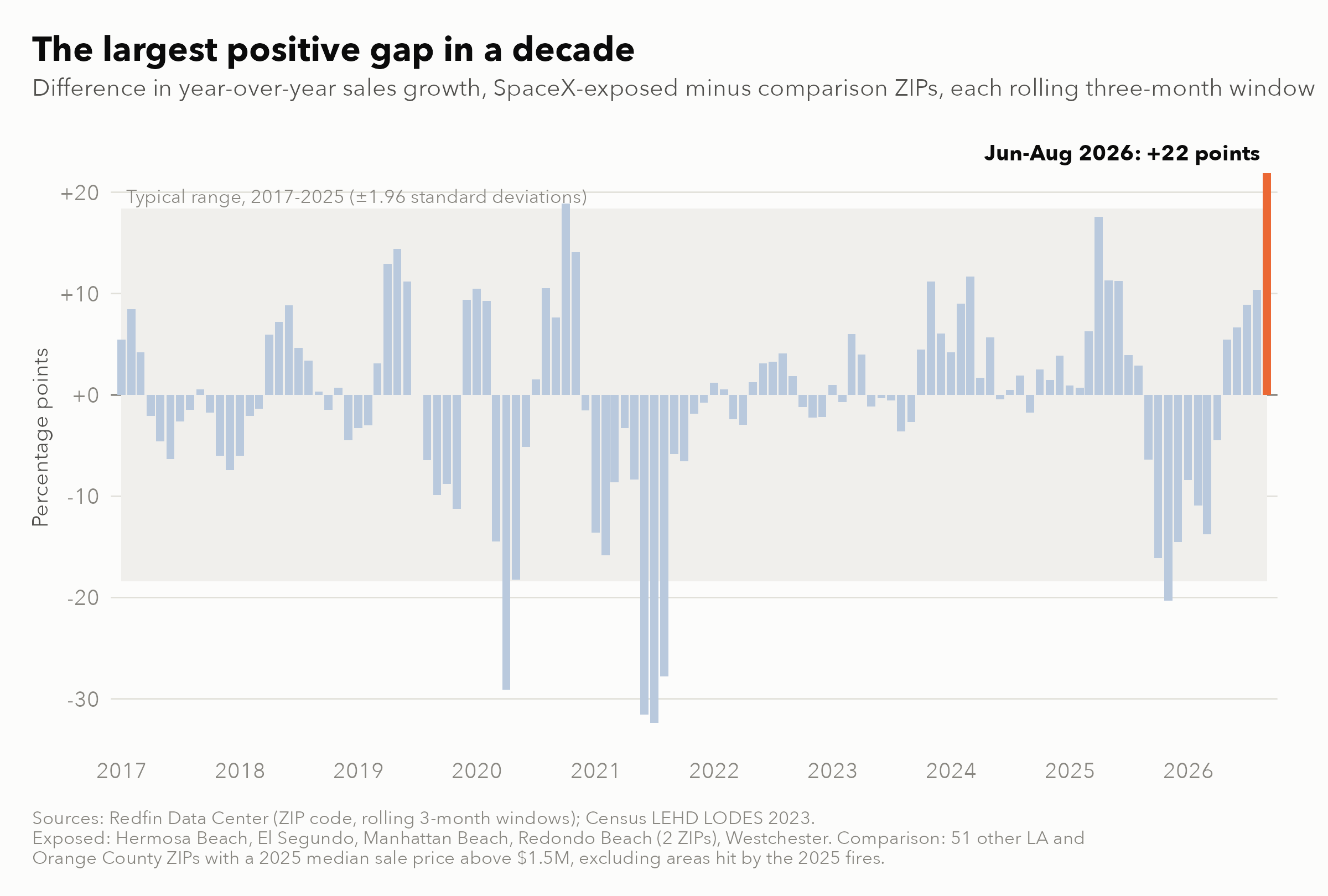
The gap is unusual. The 22-percentage-point difference is the largest positive gap we observe in any three-month window since 2017. To check whether this could be due to luck or randomness in the data, we repeatedly picked six expensive ZIP codes at random from the comparison group and measured the same gap. Only about 1 in 200 of these random groups showed a gap this large.
Prices have barely moved, at least so far. We find no meaningful change in sale prices or in Zillow’s estimated values for high-end homes.
A note of caution about these findings is that it is still very early. Most employee shares remained locked up during this period. The estimates suggest a response to expected wealth rather than to cash in hand, and this analysis does not claim any causality but points to suggestive evidence.
Data and Approach
We start by identifying where SpaceX workers live. The Census Bureau’s LEHD Origin-Destination Employment Statistics (LODES) link each job to the census block where the employee works and the block where they live. In the 2023 data, the census block containing the SpaceX Hawthorne campus accounts for about 7,600 jobs. For each ZIP code, we compute the number of these workers per 1,000 working residents. SpaceX workers are spread widely across the region: the 20 ZIP codes with the most SpaceX workers account for only 29% of all SpaceX Hawthorne workers. The highest concentrations are in Hermosa Beach, El Segundo, Playa del Rey, Redondo Beach, Hawthorne, and Manhattan Beach.
We then focus on expensive neighborhoods, which we define as ZIP codes with a median sale price above $1.5 million in the summer of 2025. Six of them have at least four SpaceX workers per 1,000 working residents: Hermosa Beach, El Segundo, Manhattan Beach, Westchester, and two Redondo Beach ZIP codes. These form our “exposed” group. The map below shows where SpaceX Hawthorne workers live and outlines the six exposed ZIP codes.
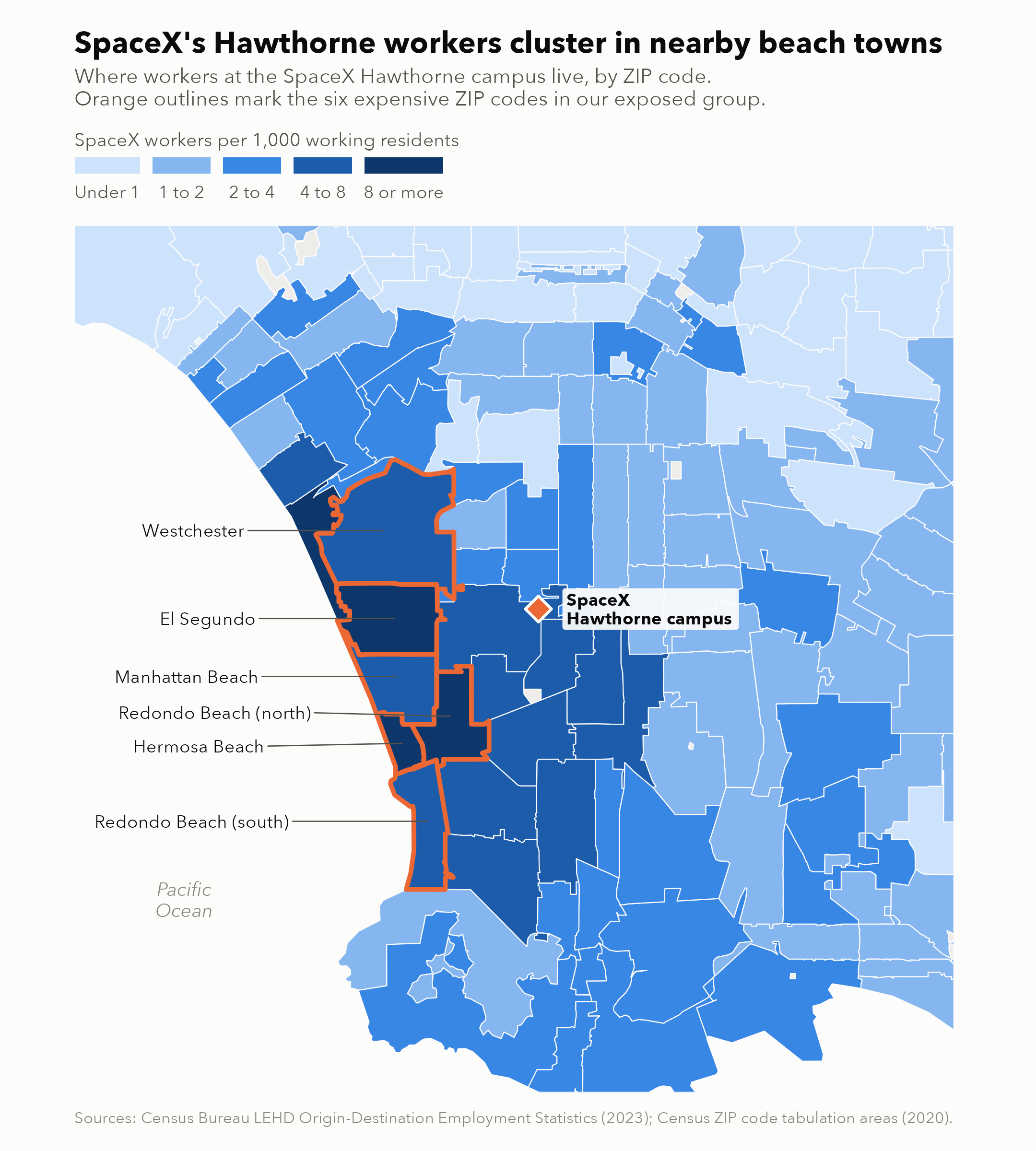
SpaceX workers are most concentrated in the beach towns just west and south of the campus. Some nearby ZIP codes with high concentrations, such as Hawthorne itself and Playa del Rey, are not in our exposed group because their median sale price is below $1.5 million.
The comparison group includes 51 other expensive ZIP codes in Los Angeles and Orange counties with fewer than two SpaceX workers per 1,000 residents. We exclude areas directly affected by the January 2025 Palisades and Eaton fires, which, as we documented in previous R.E.A.L. posts, experienced unusual sales activity of their own.
For housing market outcomes, we use the Redfin Data Center, which reports homes sold, pending sales, new listings, and median sale prices by ZIP code over rolling three-month windows, through August 2026. We complement it with Zillow’s Home Value Index for the top third of homes in each ZIP code.
SpaceX publicly filed its registration statement with the Securities and Exchange Commission on May 20, 2026, and began trading on June 12. However, most employees could not sell their shares right away: pre-IPO shareholders face a lock-up period of up to 180 days, which ends in early December, with some shares unlocked earlier. So far, there have been four different unlocks (on August 6 and 20, and September 9, and 24).
Home Sales Jumped Where SpaceX Workers Live
The figure below compares the year-over-year change in homes sold in the exposed and comparison ZIP codes.
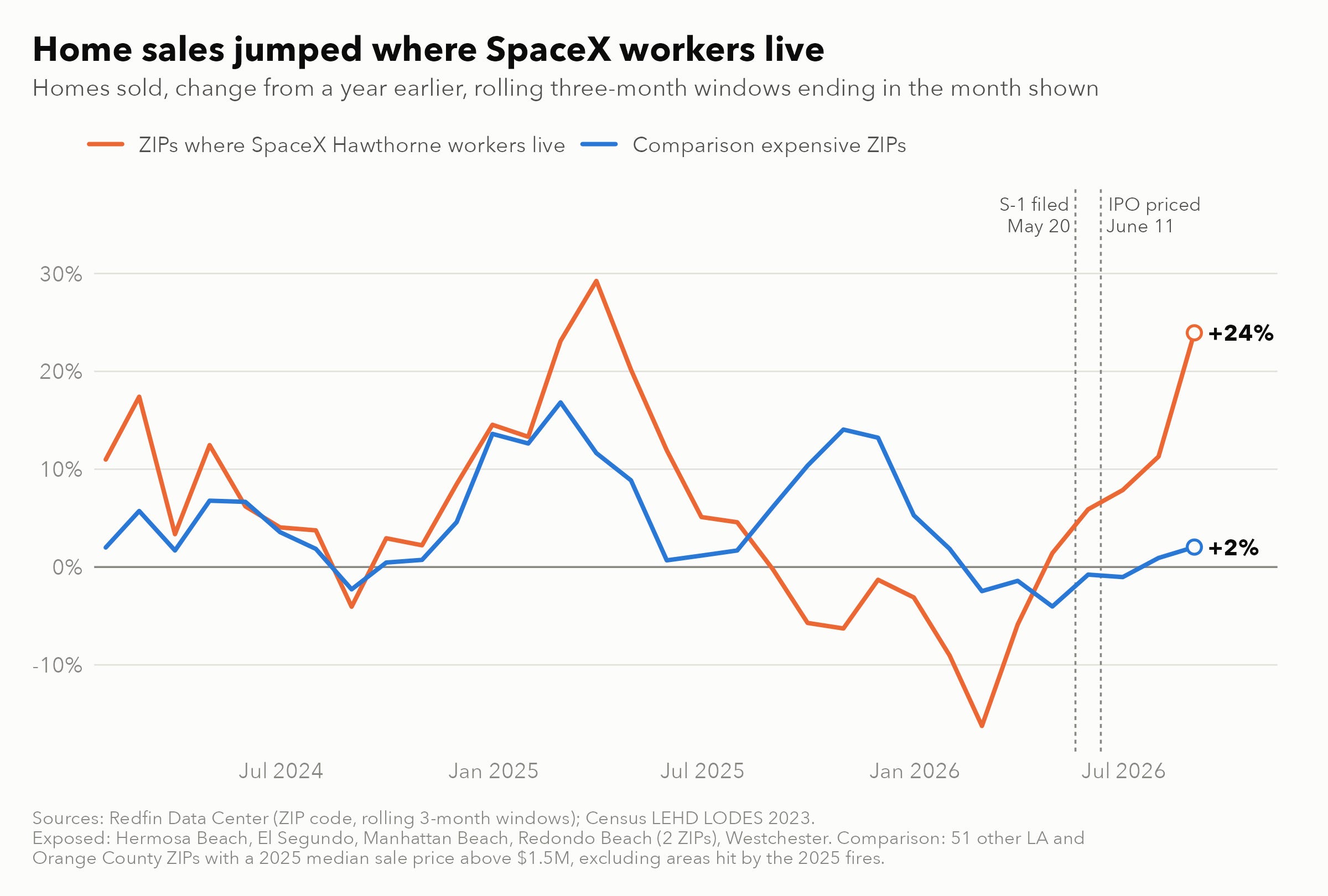
Through 2024 and much of 2025, the two groups moved broadly together. In late 2025 and early 2026, the exposed ZIP codes actually underperformed, with sales down 16% year over year in the winter months. The pattern then reversed, and the gap turned positive in the spring and increased after SpaceX’s IPO. We find that sales in the exposed ZIP codes were up 8% in the April-June window, 11% in May-July, and 24% in June-August. Over the same windows, sales in the comparison group were roughly flat.
In absolute terms, the exposed ZIP codes recorded 497 sales between June and August 2026, against 401 a year earlier. Had they grown at the comparison group’s pace, we would have expected about 409. The difference of roughly 90 additional sales translates to approximately $190 million in additional transactions at the typical sale price of about $2.1 million in these neighborhoods.
Pending sales, which capture signed contracts before they close, tell the same story. The gap in pending sales rose from about 7 percentage points in the spring to 21 points in the May-July window. This is the timing we would expect if buyers signed contracts around the filing and the listing, and closed over the following weeks.
How Unusual Is This?
Neighborhood sales are noisy, so a natural question is whether a gap of this size could arise by chance. We provide two tests in support of our findings.
First, we compute the same gap for every rolling three-month window since 2017. The figure below shows that the June-August 2026 gap of 22 points is the largest positive gap in the series. The previous high, 19 points, occurred in the fall of 2020 during the pandemic craze.
Second, we run a simple placebo test. We repeatedly pick six ZIP codes at random from the comparison group, pretend they are the exposed group, and compute their gap relative to the remaining comparison ZIP codes. The figure below shows the results of 5,000 such draws.
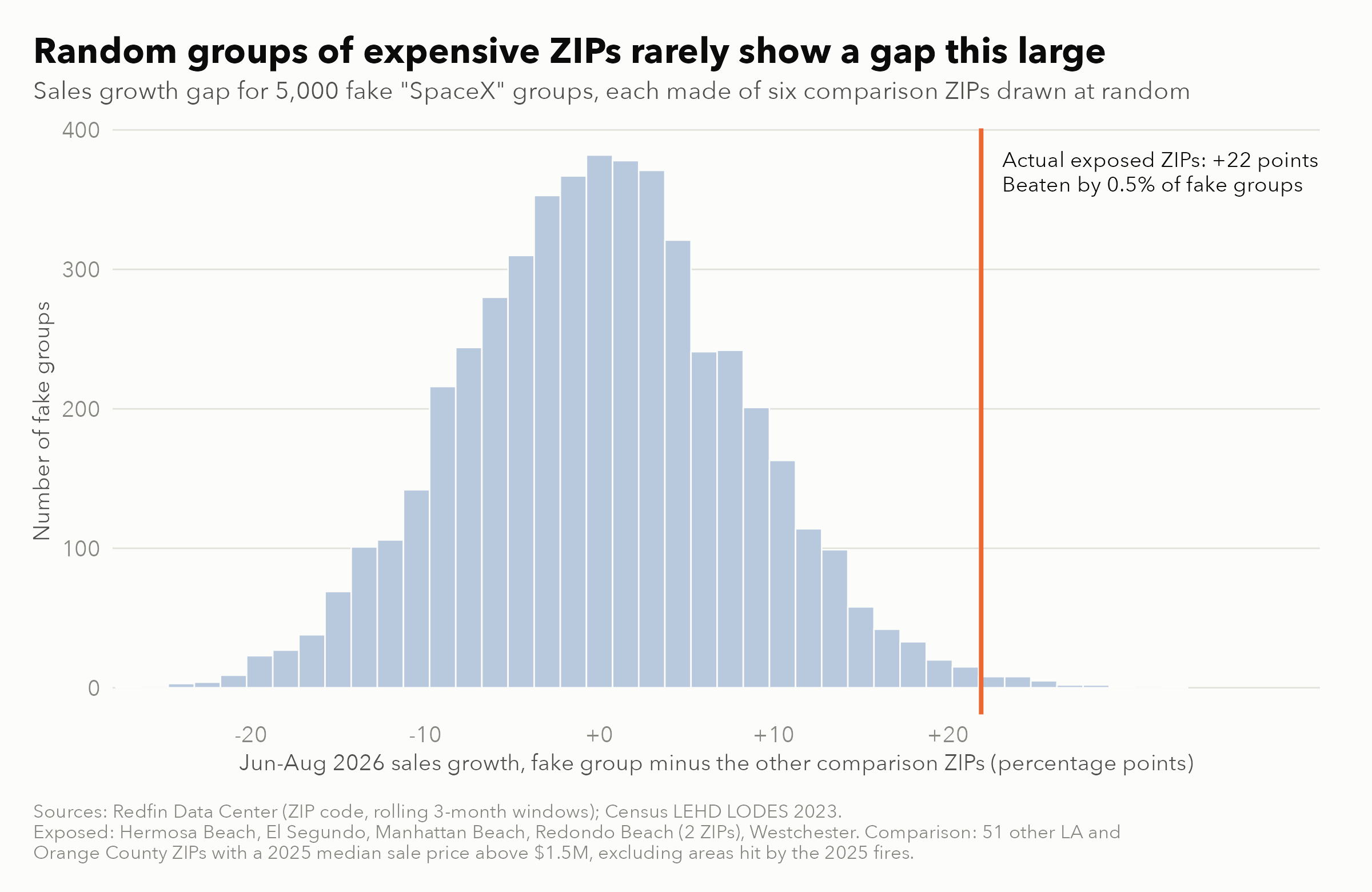
Only 0.5% of the placebo groups produce a gap as large as the one we observe. In addition, the result does not depend on any single neighborhood. Dropping one exposed ZIP code at a time leaves a gap between 18 and 30 points.
Sales rose most in El Segundo (up 83%, from a small base) and Hermosa Beach (up 55%), the two ZIP codes with the highest concentration of SpaceX workers, and were flat in one Redondo Beach ZIP code.
Finally, the relationship holds when we use exposure as a continuous measure across 164 ZIP codes with median prices above $1 million. Each additional SpaceX worker per 1,000 residents is associated with about 2.8% more sales in the post-IPO window. For Hermosa Beach, with about 12 SpaceX workers per 1,000 residents, this implies roughly 40% more sales.
Prices Have Barely Moved
While sales seem to have moved substantially, prices have barely responded, at least so far. Median sale prices in the exposed ZIP codes did not rise relative to the comparison group, and the difference in Zillow’s top-tier home values increased by less than 1% between April and August 2026. This is consistent with a recent study of California IPOs between 1993 and 2017 by Hartman-Glaser, Thibodeau, and Yoshida, published in Real Estate Economics, which finds that home prices within 10 miles of a newly listed company rise by about 1.0% after the filing and 0.8% after the listing. Effects of this size are hard to detect over a few months in a handful of neighborhoods.
The same study finds roughly no additional effect when lockups expire, suggesting that shareholders adjust their housing demand when they learn they are wealthier, not when they can sell. If this holds for SpaceX, the response we document may reflect a substantial part of the effect rather than its beginning.
Looking Ahead
The evidence suggests that the SpaceX IPO coincided with an unusual surge in home sales in the expensive neighborhoods where SpaceX workers live, with little effect on prices so far. However, this is a first look based on a single post-IPO window. The coming months could be more telling as employee lockups continue to expire, and Redfin’s fall data will show whether the surge persists. We plan to revisit these patterns as new data arrive, and to extend the analysis to SpaceX’s sites in Texas, where the company moved its headquarters in 2024.